
Related case study


By Michal Komarzynski, Chief Delivery Officer, ideaHelix
Michal is a hands-on delivery leader with 20+ years of experience driving Salesforce and telco transformations across 15+ countries. Before joining ideaHelix, he led the Salesforce CPQ and Salesforce Industries practice globally at IBM Consulting. At ideaHelix, Michal leads Global Delivery, overseeing solution strategy, architecture, deployment, optimization and managed services for large-scale programs on Agentforce Revenue Management and Salesforce Industries.
Most conversations about AI in enterprise software ask the wrong question. “Will AI improve the UI?” “Which copilot is best?” The bigger shift is that traditional enterprise applications are becoming less visible. The platforms that orchestrate data, decisions, workflows, and agents are taking over. Companies are starting to operate through AI agents at scale, with workflow orchestration across systems, real-time decisioning, and human teams supervising exceptions instead of executing repetitive steps.
That shift changes what a Salesforce consulting partner has to be good at. The old SI playbook (heavy UI customization, manual configuration, large offshore teams) does not scale into the agentic era. The new differentiator is who can architect AI-enabled operating models, agent frameworks, and secure integration fabrics that hold up in production.
We are not waiting for that future at ideaHelix. We are delivering programs with it now.
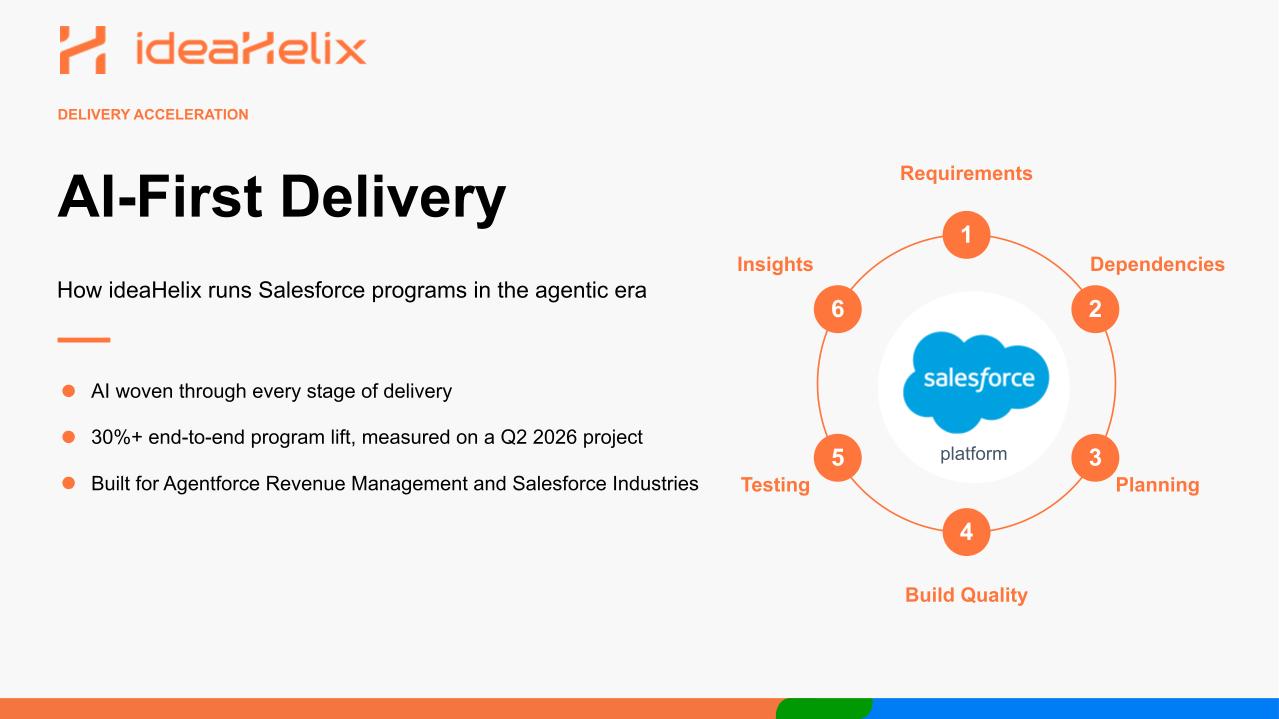
AI-First Delivery is how we run Salesforce programs end-to-end, with AI woven through every stage rather than bolted on at the end. Claude Code and other large-model tooling are accelerating delivery on a deployment we just completed for a major US health insurance provider on Sales Cloud. The same model carries directly across to complex programs in Agentforce Revenue Management, Agentforce Communications, and other Salesforce Industry clouds.
This is not about replacing our people with AI. It is about putting AI behind every part of the delivery lifecycle so our practitioners spend their time on the work that needs human judgement.
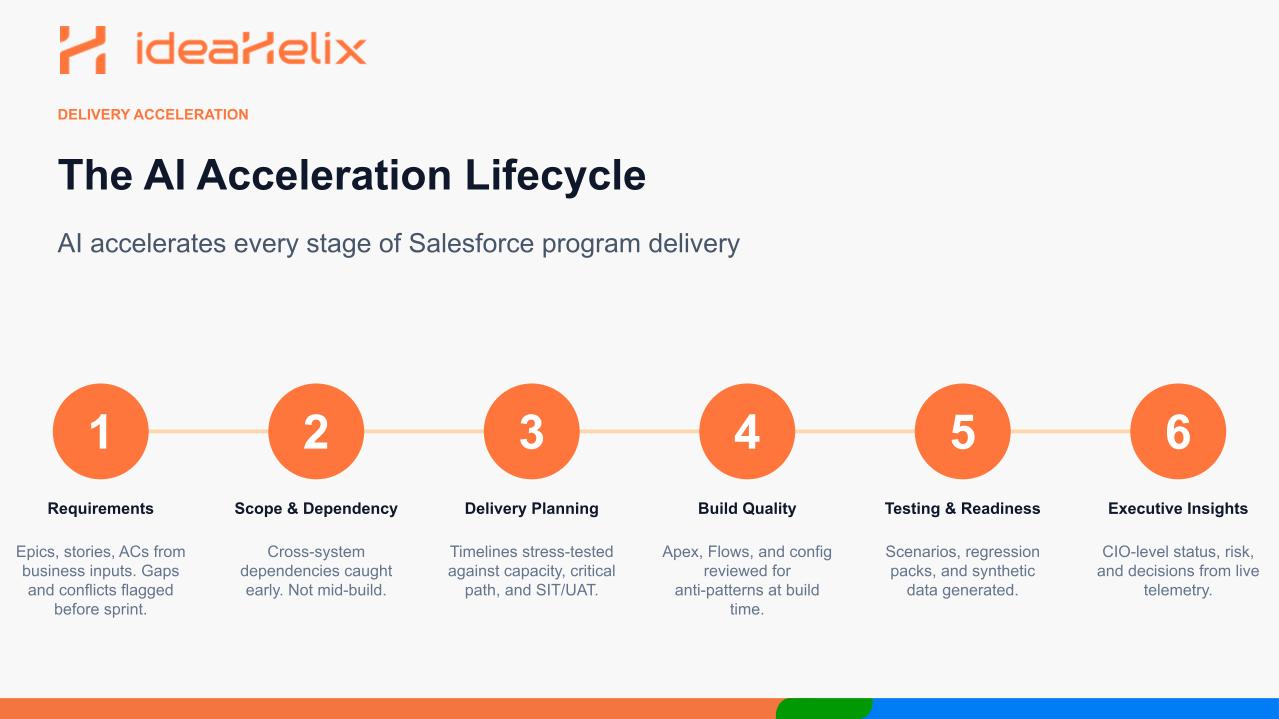
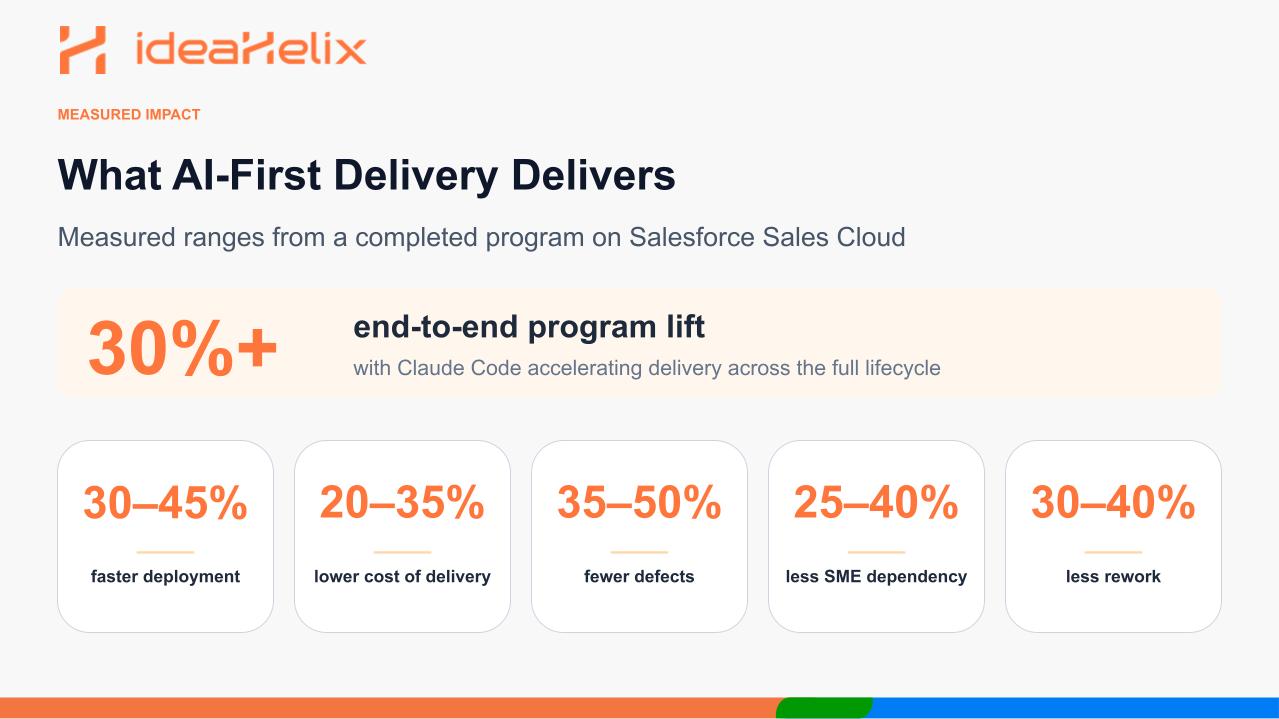
Faster, cleaner programs with fewer surprises. On the program we just completed in Q2 2026 for a US health insurance provider, AI-First Delivery delivered a 30%+ end-to-end program lift, with measured ranges of:
These are not lab numbers. They are internal delivery metrics from a complex Salesforce program in production. Results will vary by program complexity, but the trajectory is clear.
The integrator’s role is shifting. We are not implementing software any more. We are engineering autonomous enterprise operations on Salesforce, and helping customers arrive on Agentforce, Agentforce Revenue Management, and Salesforce Industries with a foundation that is ready to run agents, not just hold data.
The question for buyers is changing with it. It is no longer “how many screens can your team build?” It is “can your team architect, deliver, and govern the systems that will run our agentic enterprise?”
“Salesforce programs used to be measured by how fast you could build screens. The next generation will be measured by how cleanly AI runs inside the enterprise.”
Michal Komarzynski
Chief Delivery Officer, ideaHelix
If you are scoping an Agentforce deployment, a Salesforce CPQ to Agentforce Revenue Management migration, or a Salesforce Industries transformation in the next two quarters, get in touch. We will compare your timeline and team-size assumptions against what we just learned on this build, and you walk away with a concrete view of where AI-First Delivery could compress cost, risk, and cycle time on your program.







If you want help with an existing Salesforce Industries deployment or to scale your business with Revenue Cloud ideaHelix can deliver faster and better Salesforce outcomes.
"*" indicates required fields