

Related case study


By Prashant Gupta, Director of Product Management, ideaHelix
Prashant is a Global Product Leader with over 16 years of experience driving CRM, AI, and enterprise platform innovation. A 55x Salesforce-certified professional, including Agentforce Specialist, Application Architect, and Systems Architect, he leads product vision, strategy, and delivery for ideaHelix’s portfolio of automation tools and Agentforce agents.
Anyone can show an agent demo: a chat window, a scripted prompt, and a clean answer. The real test starts after the demo, when agents must work with live data, business rules, approvals, and security, when agents stop answering questions and start getting real work done.
We build agents differently. We use standard Agentforce building blocks, keeping your solution upgrade-safe, governed, and easy to evolve. We keep people in control with guided actions, approvals, and built-in guardrails. We place agents where work already happens: Console Apps, Record Pages, Teams, and Slack. Because every agent is grounded in the customer’s Salesforce data model and business processes, we can stand up a working version in days.
The result: four Agentforce agents solving four real business problems. Each shows faster time to value, better user experience, reduced manual effort, stronger KPI visibility, and more informed decision-making at the point of work.
Our deepest Agentforce investment: a guided revenue agent embedded inside Agentforce Revenue Management. It supports the full revenue lifecycle, from quote creation to order, contract, assets, amendment, and renewal, all from one trusted workspace.
Start a quote and the agent surfaces recent deals, buying history, whitespace opportunities, and commercial context. Ask for a quote and it builds one with the right products, pricing, and commercial terms. At pricing, it recommends a deal-appropriate discount. If the discount crosses policy, it routes the approval to the Sales Manager automatically. The revenue impact updates in real time.
Then it continues where most demos end. It creates the order, supports mid-contract amendments, updates assets, and prepares the renewal path. And when asked to create a contract from an open deal, it refuses because the business rule requires contracts to come from closed deals. That’s the difference: enterprise agents don’t just act fast. They act within policy.
The impact is faster quote-to-cash execution, cleaner approvals, reduced revenue leakage, more renewals, improved sales experience, and better commercial decisions at every stage of the revenue lifecycle.
An Agentforce Media assistant embedded inside an advertising proposal builder. Sellers move through guided steps: scope, products, pricing, and review. The agent supports each step with account intelligence, campaign context, recommendations, and governed next actions.
Open a proposal and the agent already understands the advertiser: prior campaigns, buying patterns, budget signals, and goals. It recommends flight dates, budget, audience, and market coverage, then selects media products from the catalog to match the campaign objective.
At pricing, it recommends a discount that stays within approval rules. It generates the client-ready pitch deck and attaches it to the opportunity. Contract, order, amendment, and renewal are available in the same flow.
The design principle is simple: the agent recommends, the seller decides. That is how AI earns adoption with sales teams who want better guidance, not loss of control.
The result: proposals in minutes instead of hours, backed by account intelligence, with pricing discipline built in.
A guided selling agent for communications deals, where one opportunity spans dozens of service locations, hundreds of line items, and layered commercial terms. It runs inside Agentforce Communications, and reaches sellers where they already work: Slack, Teams, and email.
The agent opens the deal with context already in place: account, open opportunity, existing subscriptions, and the commercial signals around them. The seller starts from a proposed configuration, not an empty quote.
Locations live inside the quote, so customer, products, and deal economics sit in one view. Build a configuration once and reuse it across the other sites. Product discovery replaces catalog hunting, recommending best-fit offers from the configuration in front of it.
Then term, billing frequency, and discount. Ask in plain language whether a structure holds up and the answer comes back inside the approval rules. Terms, pricing, and location detail carry forward into order capture, fulfillment, and the asset lifecycle, so changes and renewals start from what was actually sold.
The same agent works off-platform. An AE pastes 42 site addresses into Slack and gets 42 service locations and 200+ priced line items in Salesforce, in one transaction. The proactive version reads an inbound email and has the quote ready before the rep starts typing.
In communications, the hard part was never the product. It was the 42 locations, the approvals, and the handoff to fulfillment. That’s the part this agent takes on.
The result: multi-site quotes in minutes, fewer errors, and a clean path from opportunity to an order ready for fulfillment.
An agent embedded inside an internal Policy Management Console on Salesforce Digital Insurance, connected to live policies, cases, brokers, agencies, service requests, and trusted data sources. It is not built for selling. It is built for the teams who keep insurance operations moving.
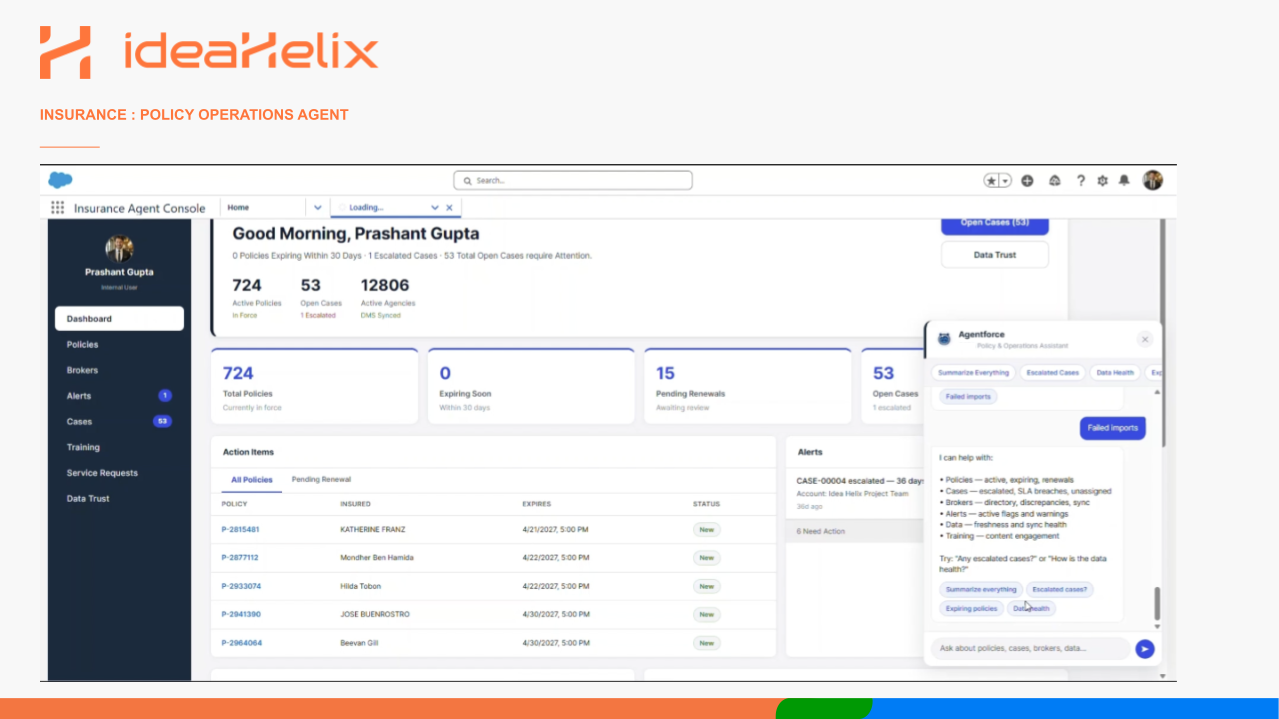
Teams simply ask: Any escalated cases? Which policies are expiring? Any broker issues? Which SLAs are breached? The agent answers with real case numbers, owners, dates, and next actions. Follow-ups work like a normal conversation: “Which ones?”, “Who owns those?”, “Show the highest priority.”
Every answer includes actions that take you straight to the record needing attention. The agent doesn’t just report SLA breaches. It helps resolve them. And leadership can ask for one operational summary: escalations, breaches, data issues, and what needs attention first.
The result: faster triage, fewer missed SLAs, and decisions made at the point of action.
Sales agents. Operations agents. Conversation where it helps. Guided actions where it counts. Four industries, one architecture: standard Agentforce capabilities, governed workflows, human control points, and agents embedded where work happens.
That’s why they deploy quickly. We aren’t creating a custom AI stack for every customer. We build on the Salesforce platform, align to the customer’s real data model and processes, and apply governance from day one.
“The best agent isn’t the most autonomous one. It’s the most trusted one. That’s what earns a place in production.”
Prashant Gupta, Director of Product Management, ideaHelix
Contact us to book a demo and see these agents working in real Salesforce workflows.







If you want help with an existing Salesforce Industries deployment or to scale your business with Revenue Cloud ideaHelix can deliver faster and better Salesforce outcomes.
"*" indicates required fields